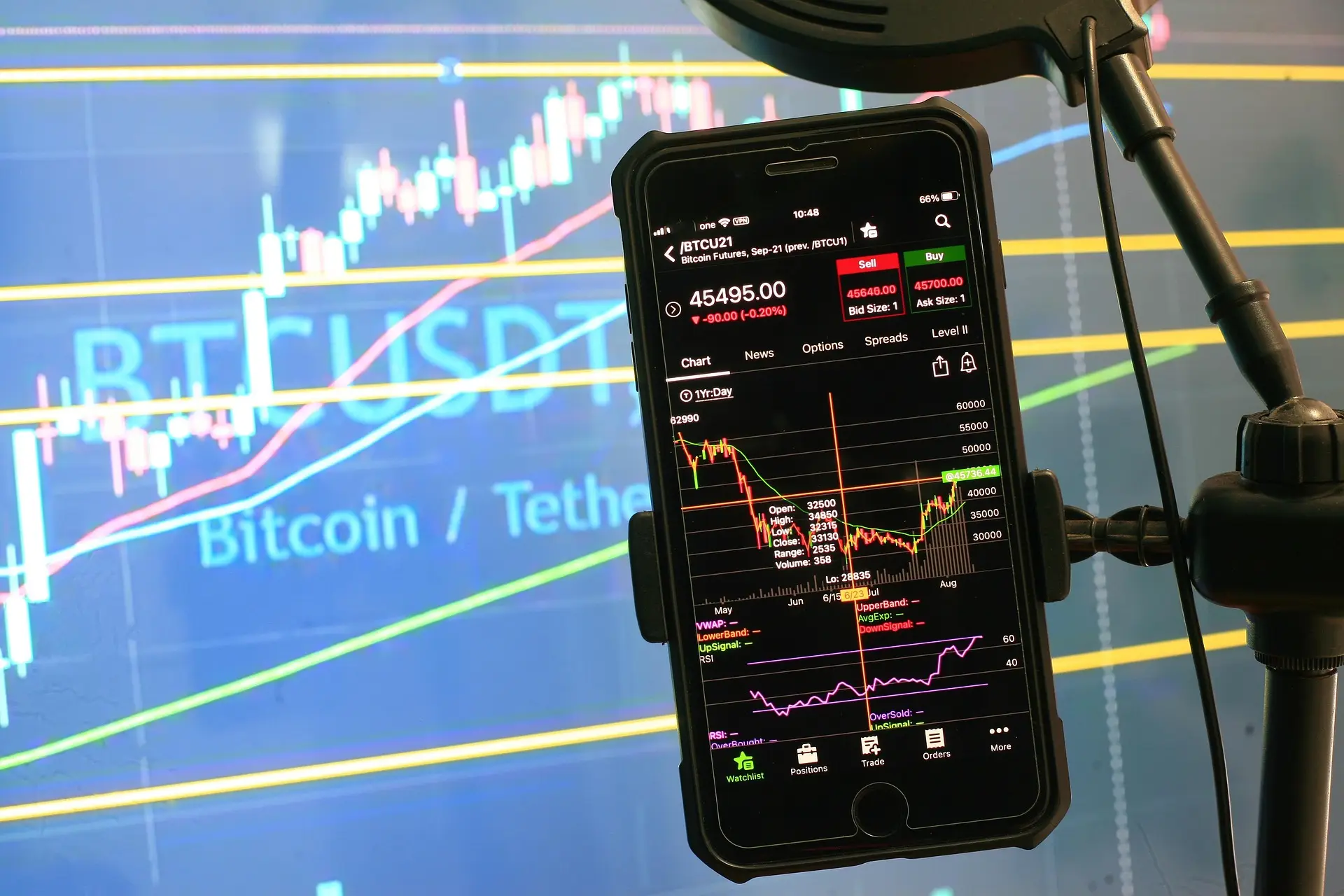
01Spot trading: you own the coin
Spot crypto trading means buying the coin itself at today's price, with fiat or a stablecoin. Tap "buy BTC", the order fills, and bitcoin appears in your account. You can hold it, sell it or withdraw it to your own wallet. Japan's 現物取引, the KRW markets on Korean exchanges and the retail order books at Hong Kong's licensed platforms are all spot.
The risk in spot is easy to understand. If the price falls 30%, your $1,000 of bitcoin is worth $700, but you still hold exactly the same amount of BTC, and nobody can close your position for you. That is why our beginner's guide deals only with spot: its worst case is something you can picture in advance.
Spot costs are trading fees and spreads. Base spot fees at the large international exchanges sit around 0.10%, while Japan's "販売所" dealer desks advertise zero fees but quote spreads that can reach 1–5%. Our fee comparison breaks down what you really pay.
02Futures and perpetual contracts: trading a price agreement
Crypto futures trading is not about coins at all. You trade an agreement: if the price rises, the long side gains; if it falls, the short side gains. You never hold bitcoin, and you cannot withdraw any. Your account shows a "position" and the "margin" backing it.
Dated futures expire on a fixed date and settle according to the contract terms, the same structure that sits behind the bitcoin futures ETFs listed in Hong Kong. Perpetual contracts ("perps") are crypto's own invention: they never expire, and a funding rate keeps their price anchored to spot. USDT-margined perpetuals now account for the biggest share of volume at international exchanges.
Spot
- You own real coins and can withdraw them
- No leverage, so no liquidation price
- Maximum loss = what you paid
- Costs: trading fee + spread
- Offered by most licensed Asian platforms
Perpetual futures
- You hold a position, not coins
- 1x to 100x leverage is common
- A small adverse move can liquidate you
- Costs: fees + funding + liquidation fees
- Restricted or banned for retail in several Asian markets
The pull of futures is leverage: $1,000 of margin controls a $10,000 position. Futures also let you go short or hedge coins you already hold, and professionals use them for exactly that. The trouble is that most retail traders are not hedging. They want a small stake to win big.
03Leverage and liquidation: a worked example
The numbers below are purely hypothetical. They illustrate the mechanics and say nothing about where prices are heading. Assume bitcoin is at $50,000 and you have $1,000.
| Scenario | Spot: buy 0.02 BTC | 10x long ($10,000 notional) |
|---|---|---|
| Price rises 10% to $55,000 | +$100 (+10%) | +$1,000 (+100%) |
| Price falls 5% to $47,500 | −$50, still hold 0.02 BTC | −$500, half the margin gone |
| Price falls ~9.5% to $45,250 | −$95 | Liquidated, margin essentially gone |
| Price then returns to $50,000 | Back to even, coins intact | No position left, loss is final |
Assumes a 0.5% maintenance margin rate; excludes fees and funding. Liquidation rules differ by exchange.
Why does the position die at −9.5% rather than −10%? Exchanges make you keep a slice of "maintenance margin" at all times. A rough formula for a long is: liquidation price ≈ entry × (1 − 1/leverage + maintenance margin rate). Here that is $50,000 × (1 − 0.1 + 0.005) = $45,250. Switch to 50x and liquidation sits roughly 1.5% below entry, and bitcoin moves 2% in a day all the time.
Two more things catch people out. First, fees are charged on notional size: at an assumed 0.05% taker fee, opening and closing a $10,000 position costs $5 each way, or 1% of your $1,000. Second, fast markets bring slippage and gaps: liquidation orders do not always fill at the liquidation price, and depending on the exchange an insurance fund or auto-deleveraging steps in. The real outcome can be worse than the formula.
04Funding rates: the cost nobody shows you upfront
If a perpetual never expires, what keeps its price in line with spot? The funding rate. When perps trade above spot, as they do when the market is bullish, longs pay shorts every interval. When perps trade below spot, shorts pay longs. Many exchanges settle every 8 hours; some contracts settle every hour or every 4 hours. Check the contract specification.
Back to our example: a $10,000 position paying a steady 0.01% every 8 hours costs about $3 a day, or roughly $1,095 a year, more than the $1,000 of margin you started with. In euphoric markets rates go higher. Nothing pops up when you open the trade; the payments are simply deducted from your balance.
Funding is also what some "arbitrage bots" try to harvest: buy spot, short the perp, collect the funding. It is not risk-free (exchange risk, liquidation risk on the short leg, funding flipping negative), and we cover it in our trading bots guide.
Rather not calculate liquidation prices or pay funding? Buying spot is the simplest route.Buy with Visa, Mastercard, Apple Pay or Google Pay
Buy Bitcoin now05How Asian regulators treat crypto derivatives
"Crypto contract trading platforms" are a sensitive topic in Asia. Many regulators that accept spot trading are far more cautious about retail derivatives, for an obvious reason: leveraged products lose ordinary investors money very fast. Here is the picture as of October 2026, based on official sources.
Singapore: no leverage for retail. The Monetary Authority of Singapore's consumer-protection guidelines (PS-G03) bar licensed digital payment token providers from offering lending or leverage to retail customers, and from accepting locally issued credit cards. See MAS and our Singapore guide.
Hong Kong: perpetuals for professional investors only. In 2026 the Securities and Futures Commission set out a framework for perpetual contracts at licensed virtual asset trading platforms, open only to professional investors (for individuals, a portfolio of at least HK$8 million). Retail customers on licensed platforms trade spot. Binance has kept derivatives closed to Hong Kong users since 2021. The licensed list is on the SFC website.
Japan: leverage exists, but at low multiples. Exchanges registered with the Financial Services Agency offer "レバレッジ取引". JVCEA data show 2.24 million margin accounts and about ¥628 billion of margin trading in July 2026. Leverage for individuals is capped by regulation; 2x is the standard industry limit, a world away from the 100x offered offshore. Bybit stopped accepting new Japanese sign-ups at the end of October 2025.
South Korea: domestic exchanges are KRW spot markets. The KRW exchanges reported to the Korea Financial Intelligence Unit run spot markets. Some Korean traders move USDT or XRP to offshore derivatives venues, but an unreported foreign exchange that targets Koreans breaches the Specified Financial Transaction Information Act, and Upbit blocks withdrawals to unreported platforms.
Mainland China: crypto derivatives are illegal financial activity. The People's Bank of China and nine other agencies listed "virtual currency derivatives trading" alongside exchange and matching services as illegal in their 2021 notice. Offshore platforms serving mainland residents are covered too, and related contracts are void. We do not describe workarounds; see crypto in mainland China.
Thailand and the Philippines: unlicensed offshore venues get blocked. Thailand's SEC has blocked Bybit, OKX and others since June 2025, and the country's 2025–2029 capital-gains exemption explicitly excludes derivatives. The Philippine SEC named several unregistered offshore platforms in 2025, and Bybit was pulled from the local Play Store and blocked in March 2026.
Where licensed local derivatives exist: Indonesia's OJK now permits crypto futures at some licensed traders (about Rp5.8 trillion of derivatives volume in March 2026). In India, FIU-IND-registered Delta Exchange India offers futures and options, and Coinbase launched perpetuals there in May 2026. Dubai's VARA licences cover derivatives at Binance, Crypto.com and Deribit, and Pakistan's PVARA lists derivatives among its ten licence categories. A licence means the venue is supervised. It does not make leveraged trading safe for you.
06"Second contracts", signal groups and fake platforms
Chinese-language social media is full of ads for 秒合约 ("second contracts"), "speed contracts" and "30-second up/down" trading. These have nothing to do with real futures or perpetuals. They are binary-option-style bets in which the platform is both the house and the referee, controlling settlement prices and withdrawals. Many so-called contract platforms have no real matching engine at all, only an app showing fake prices.
The script is familiar: a stranger adds you on a messaging app and invites you into a "mentor" or signal group. You win a few small trades and withdraw without trouble. Once you deposit more, the account is suddenly "liquidated" or "frozen for violations", and you are told to pay a "margin top-up" or "tax" to release funds. Hong Kong police recorded 5,135 online investment fraud cases in 2025 with losses of about HK$3.58 billion, roughly a third of which involved virtual assets.
07What beginners should do
If you still need futures for a clear purpose such as hedging, at minimum: trade only on a platform that is licensed where you live and accepts residents of your country; use isolated margin and low leverage; write down your liquidation price before opening; and never put rent money or borrowed money into a derivatives account. Our trading platform rankings and country guides help with the first step.
FAQ
What is the main difference between spot and futures trading in crypto?
Spot trading buys the actual coin: you own it, can withdraw it to your own wallet, and if the price falls you still hold the same number of coins. Futures and perpetual contracts are agreements that track the price. You never own the coin, positions are usually leveraged, and a modest move against you can trigger liquidation, wiping out the margin you put up within minutes.
What is a funding rate on perpetual futures?
Perpetual contracts never expire, so exchanges use a funding rate to keep the contract price close to spot. When perps trade above spot, longs pay shorts at set intervals; when they trade below, shorts pay longs. Many venues settle every 8 hours, some every 1 or 4 hours. A 0.01% rate looks tiny, but it is charged on the full leveraged position, so it compounds quickly.
At 10x leverage, how far does the price have to fall before I am liquidated?
A 10x long loses its entire margin after roughly a 10% drop. Because exchanges also require maintenance margin, liquidation usually comes earlier, for example around a 9–9.5% fall depending on the venue's maintenance margin rate and fees. At 50x leverage, a move of about 2% against you can be enough. Higher leverage means less room for error, not more profit.
Which Asian regulators restrict retail crypto derivatives?
Singapore's MAS bars licensed platforms from offering lending or leverage to retail customers. Hong Kong's SFC limits perpetual contracts on licensed platforms to professional investors. Mainland China's 2021 ten-agency notice treats crypto derivatives as illegal financial activity. Japan allows leverage at registered exchanges but caps it at a low multiple. Indonesia, the UAE and India have locally registered or licensed derivatives venues.
What are "second contracts" (秒合约) and are they legitimate?
So-called second contracts or "speed contracts" are usually binary-option-style bets on whether the price goes up or down within seconds. They are not real futures. They appear mostly in unknown apps and social-media groups, where the platform is your counterparty and can manipulate settlement prices or refuse withdrawals. Our advice is simple: avoid them, and block strangers who invite you to "signal groups".
Sources
- MAS — Guidelines on Consumer Protection Measures by DPT Service Providers (PS-G03) · checked Oct 2026
- SFC — Lists of virtual asset trading platforms · checked Oct 2026
- PBoC and nine agencies — Notice on preventing virtual currency trading speculation risks (2021) · checked Oct 2026
- JVCEA — monthly crypto trading data, July 2026 · checked Oct 2026
- Hong Kong Police — 2025 law and order statistics · checked Oct 2026
- Thai SEC — licence check · checked Oct 2026
Just want to own some crypto?
Spot is enough. Buy real bitcoin with a card: no liquidation price, no funding payments. Check first that the platform serves your country.
International licensed platform · operating since 2013 · Visa / Mastercard / Apple Pay